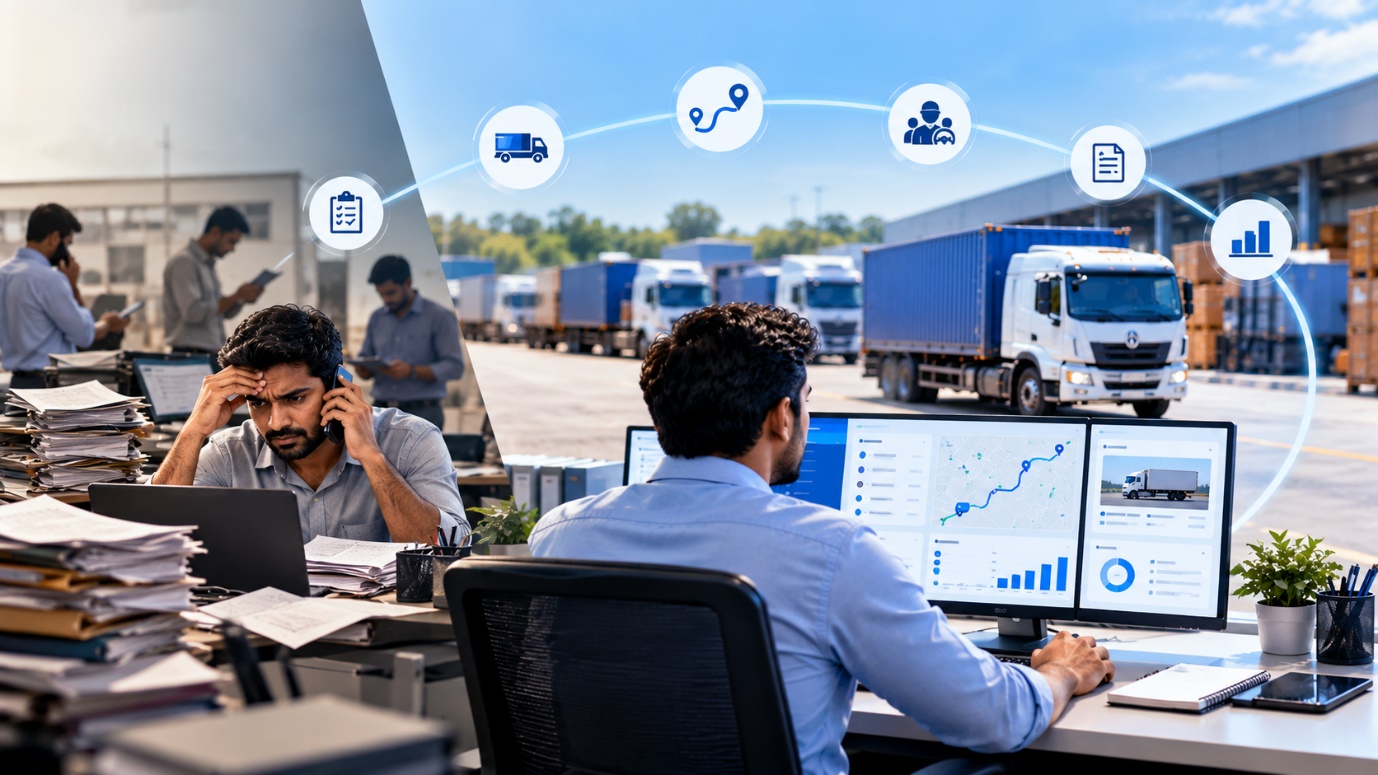
Running a transport business today is no longer just about moving goods from one location to another. Transporters have to coordinate vehicles, drivers, shipments, routes, customers, payments, documentation, and delivery updates — often at the same time.
As the number of shipments and vehicles grows, managing everything through spreadsheets, phone calls, WhatsApp messages, and manual registers can quickly become difficult.
This is where transport management solutions can make a meaningful difference.
Modern transportation technology brings planning, tracking, dispatch, documentation, billing, and reporting into connected digital workflows. Instead of adding more people and more manual processes as the business grows, transporters can use technology to manage increasing operational complexity more efficiently.
For small and medium-sized businesses, the goal isn't to make operations complicated with technology. It is the opposite: use technology to make complicated operations easier to manage.
What Are Transport Management Solutions?
Transport management solutions are digital tools designed to help businesses plan, execute, monitor, and improve transportation operations.
Depending on the business, a solution can include features such as:
- Trip and route planning
- Vehicle and fleet management
- Driver management
- Load allocation
- Shipment tracking
- Digital proof of delivery
- Freight and billing management
- E-way bill and documentation support
- Customer communication
- Performance dashboards
- Analytics and reporting
- ERP, GPS, and third-party integrations
A modern system acts as a central operating layer for transportation activities. Instead of searching across multiple systems for information, teams can access important operational data from one connected environment.
This is particularly useful for growing transporters, e-commerce businesses, manufacturers, distributors, and other companies that handle frequent shipments.
Why Modern Transporters Need Transport Management Solutions
Growth sounds simple on paper: more customers, more shipments, more vehicles, and more revenue.
Operationally, however, every additional shipment creates another set of tasks.
Someone needs to assign a vehicle. A driver needs the trip details. The customer wants an update. The accounts team needs freight information. The operations team needs to know whether the vehicle is running on schedule.
When these activities are handled manually, small gaps can quickly become larger problems.
1. Too Much Information in Too Many Places
A common problem is fragmented information.
Trip details may be stored in spreadsheets, driver updates may arrive through WhatsApp, customer information may exist in an ERP, and billing data may be maintained separately.
This makes it harder to get a complete picture of the operation.
A connected transportation management software platform can bring these workflows together, giving teams a common source of operational information.
2. Manual Planning Becomes Difficult at Scale
A transporter managing a few vehicles may be able to plan trips manually.
But as fleet size, delivery locations, and shipment volumes increase, manual planning becomes increasingly time-consuming.
Modern software for transport management can help teams organize loads, assign vehicles, manage routes, and monitor trips systematically.
The objective isn't simply automation. It is to reduce unnecessary decision-making and give operations teams better information when making decisions.
3. Customers Expect Better Visibility
Today's customers are used to tracking orders online.
They increasingly expect businesses to provide shipment status, estimated delivery information, and timely updates.
Real-time GPS tracking and digital shipment visibility can help transporters provide a more transparent customer experience.
This can be particularly valuable for e-commerce sellers and SMBs, where delivery experience directly influences customer satisfaction.
Key Features to Look for in Transport Management Software
Not every business needs a huge technology platform from day one. The right solution should match the operational problems the business actually has.
Fleet and Vehicle Management
A useful system should help businesses maintain visibility over vehicles, availability, trips, and utilization.
Instead of asking multiple people for vehicle status, managers can access relevant information through a centralized dashboard.
Trip and Route Management
Trip planning is one of the most important parts of transportation operations.
A modern system can help organize:
- Origin and destination
- Vehicle assignment
- Driver allocation
- Delivery schedules
- Route information
- Trip status
- Exceptions and delays
Advanced solutions can also use route optimization and real-time information to support better planning.
Live Tracking
GPS integration allows businesses to understand where vehicles are during a trip.
This provides operational visibility and can help teams identify delays, route deviations, or unexpected stops.
For customers, tracking also creates greater transparency.
Digital Proof of Delivery
Paper-based proof of delivery can create unnecessary administrative work.
Digital ePOD allows businesses to capture delivery confirmation electronically and make information available to relevant teams faster.
This can simplify the process from delivery completion to billing and reconciliation.
Billing and Documentation
Transportation operations involve significant documentation.
A capable platform can connect operational data with freight calculations, invoicing, payment processes, and compliance workflows.
How Transport Management Solutions Help Businesses Scale
The real value of transportation technology becomes clearer when a business starts growing.
More Shipments Without Proportionally More Manual Work
Suppose a business doubles its shipment volume.
Without technology, the operational workload may also increase significantly because employees have to enter, check, communicate, and reconcile more information manually.
With well-designed transport management solutions, many repetitive workflows can be standardized or automated.
This allows teams to focus more on exceptions and decisions instead of repetitive administration.
Better Fleet Utilization
A vehicle sitting idle is an underused business asset.
Transportation management systems can provide visibility into vehicle availability, utilization, trip schedules, and performance.
This information helps managers identify idle capacity and make better decisions about fleet deployment.
Faster Response to Problems
Transportation rarely goes exactly according to plan.
Traffic, vehicle breakdowns, customer changes, route restrictions, or loading delays can affect a trip.
The advantage of a connected system is that teams can identify exceptions earlier and respond before a small delay becomes a major service issue.
Choosing Between Off-the-Shelf and Custom Solutions
One of the biggest decisions businesses face is whether to purchase an existing platform or work with a logistics software development company to build a solution around their workflows.
When Ready-Made Software Makes Sense
Off-the-shelf transportation management software can be suitable when:
- Your workflows are relatively standard
- You want faster implementation
- You need common fleet and shipment features
- You have limited customization requirements
For many SMBs, this can be a practical starting point.
When Custom Development Makes More Sense
Custom software may be more appropriate when a business has:
- Unique transport workflows
- Multiple business models
- Existing ERP or accounting systems
- Complex integrations
- Specialized customer portals
- Large-scale automation requirements
- Industry-specific compliance needs
A logistics technology partner can map existing processes before development and build technology around the actual operation rather than forcing the business into a generic workflow.
What Should Businesses Expect From Transport Management System Providers?
Choosing among transport management system providers should involve more than comparing feature lists.
Businesses should evaluate whether the provider understands transportation operations.
Ask questions such as:
- Can the platform integrate with our existing ERP?
- Does it support GPS and live tracking?
- Can we manage drivers and vehicles from one system?
- Can the software scale as shipment volume increases?
- Can it support e-way bills and GST-related workflows?
- Can customers access shipment information?
- What reporting and analytics are available?
- How is data secured?
- What happens after implementation?
- Can additional features be developed later?
A provider with genuine logistics domain knowledge can often identify operational requirements that a generic software vendor may overlook.
How SMBs and E-commerce Sellers Can Start
Technology adoption doesn't have to happen all at once.
A practical approach is to begin with the operational area creating the most friction.
Step 1: Identify Your Biggest Bottleneck
Is your biggest issue:
- Trip planning?
- Vehicle tracking?
- Delivery visibility?
- Billing?
- Driver coordination?
- Customer communication?
- Reporting?
Start there.
Step 2: Map the Existing Workflow
Document how information currently moves from booking to delivery.
This often reveals duplicated data entry, unnecessary manual steps, and communication gaps.
Step 3: Prioritize High-Impact Features
Instead of buying every available feature, prioritize capabilities that directly address your operational problems.
For example, an e-commerce seller may prioritize shipment tracking and delivery visibility, while a transporter may prioritize fleet, trip, driver, and freight management.
Step 4: Plan for Scalability
The system you choose today should not become a limitation tomorrow.
Look for platforms that can support additional vehicles, users, locations, integrations, and shipment volumes as the business grows.
The Future of Transportation Management Is Connected
Transportation is becoming increasingly data-driven.
AI-powered route optimization, predictive analytics, real-time shipment visibility, automated dispatch, predictive maintenance, and connected dashboards are changing how logistics businesses make operational decisions.
But technology doesn't replace operational expertise.
The strongest systems combine good logistics processes + reliable data + practical software + human decision-making.
That combination allows businesses to become more responsive without making everyday operations more complicated.